BLOG
Why Task Scams Feel Like a Game (And Why That's the Trap)
Oct 7, 2026
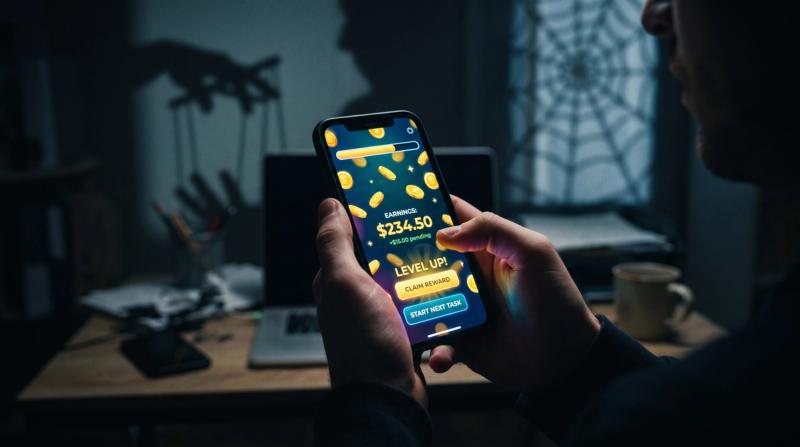
Task scams are built like mobile games on purpose. Here is how the levels, balances, and small payouts keep you hooked, and how to walk away before you pay to get paid.
A task scam stops looking like a job offer pretty quickly. It starts looking like a game. There's a balance that climbs with every click, a level you are trying to finish, and a friendly "mentor" telling you how close you are to the next payout. Gamified job scams are built that way on purpose, and once you see the design for what it is, walking away gets a lot easier.
I covered the basics in Got a Task Scam Job Offer? Here's What's Actually Happening. This piece is about the part that article only touched on: why these scams are so hard to quit once you are inside one.
How a Gamified Job Scam Actually Works
According to the FTC, task scams usually start with an unexpected text or WhatsApp message offering online work. You never applied for anything. Nobody interviews you. The "recruiter" says you can make good money from home doing simple tasks.
The work sounds harmless. You "boost" products, "optimize" apps, rate product images, or like videos inside an app or website they send you to. Each task adds a "commission" to a balance on your screen.
That balance is not money. It is a number in a database the scammer controls.
Here is how it usually plays out:
- The hook. The first sets of tasks are quick and easy, and the balance grows fast.
- The proof. Some people are allowed to withdraw a small amount early on. That real payout makes everything else feel real.
- The lock. Eventually, a task or set pushes your account into the negative, or the next level is locked. To keep going, or to withdraw what you have "earned," you are told to deposit your own money, usually in cryptocurrency.
- The loop. After you deposit, a bigger task appears that needs a bigger deposit. The balance keeps climbing on screen. It never comes out.
This is not a niche problem. In its December 2024 Data Spotlight, the FTC estimated about 20,000 task scam reports in the first half of 2024, compared to about 5,000 in all of 2023. In its 2020 sample, it found none at all.
Why the Game Design Works So Well on Job Seekers
None of the individual steps are clever. What makes these scams effective is that they borrow the same mechanics that keep people playing mobile games, and they aim them at people who are already tired and hoping for a break.
The balance feels like a paycheck
When you watch a number go up every time you finish a task, your brain treats it as earned money. You did the work. You saw the total change. Asking you to deposit $100 to unlock $800 does not feel like paying a stranger. It feels like paying a small fee to collect what is already yours.
Small payouts buy your trust
A scammer who lets you withdraw $20 has spent $20 to make you believe the system pays. That one payout does more to lower your guard than any polished pitch could. It also gives you a story to tell yourself later: "It worked before."
Levels turn quitting into losing
Progress bars, task sets, and VIP tiers all do the same job. They make stopping feel like throwing away progress. If you are one set away from the next level, walking away feels like wasting everything you put in. That's the sunk cost trap, and the game layer is built to trigger it.
The group chat does the selling for them
The FTC notes that when people hesitate to deposit, scammers often add them to a group chat where "experienced workers" share success stories. Those people are fake, or they are part of the scam. Their job is to make your doubt look like the odd one out.
A long job search makes all of it hit harder
I spent six months unemployed after 50, and I know how badly you want the next message to be the real one. Scammers count on that. A task that pays right away feels like relief after weeks of silence from real employers. That's not a character flaw. It's exactly the opening these scams are designed to use.
Red Flags Specific to Task Scams
General job scam advice still applies, and my job scam red flags for 2026 covers the wider list. These are the signs that point to a task scam in particular:
- An unexpected text, WhatsApp, or Telegram message about work you never applied for
- Pay per click, like, rating, or "product boost"
- Earnings that live as a balance inside an app instead of a paycheck through payroll
- Levels, tiers, or task sets you must finish before you can withdraw
- A "combination," "bonus," or "lucky" task that suddenly puts your balance in the negative
- Any request to deposit money, especially crypto, to unlock tasks or withdraw earnings
- A mentor or group chat pushing you to "top up" before a deadline
If you see even one request to pay to get paid, you have your answer. A real employer will never ask you to send money to collect your wages.
What to Do If You're Already In
If you are reading this partway through one of these, stop depositing. No amount of money will unlock that balance. The next deposit request is already waiting behind the one you are being asked for now.
Then take these steps:
- Don't pay a withdrawal fee, tax, or "account verification" charge. These are just more deposits with a different label.
- Save everything. Take screenshots of the chats, the app, wallet addresses, and transaction IDs.
- Call your bank or crypto exchange right away. Tell them it was a scam and ask what they can do. Speed matters.
- Report it to the FTC at ReportFraud.ftc.gov, and to the platform where it started if it came through LinkedIn, Indeed, or a messaging app.
- Ignore anyone offering to recover your money for a fee. Recovery offers are a common follow-up scam aimed at people who just lost money.
Real Jobs Don't Feel Like Games
A real job has an application, a conversation with a person, and pay that arrives through payroll. It does not have levels, a balance you can't withdraw, or a mentor nudging you to top up. If you want a full checklist for confirming a listing is real, my 12-step guide to verifying a job posting walks through each check.
We've blocked over 10,200 scam job postings at OneClick Smart Resume, and I wrote about how that screening works in why we rebuilt job scam detection from scratch. But I want to be clear about the limits. Our filters screen job listings. They can't screen a text that lands on your phone at 9 p.m. Task scams mostly skip job boards entirely, so the best defense is knowing the pattern before it reaches you.
What to Do Next
Treat any job that feels like a game as a scam until proven otherwise. Real work does not come with a progress bar, and real employers do not charge you to get paid.
When you find a real listing, make sure your resume is ready for it. Try the free Resume Health Check at check.oneclicksmartresume.com, or create a free account at oneclicksmartresume.com. Veterans get free access to the full platform.
FAQ
What is a gamified job scam? A gamified job scam, also called a task scam, pays you fake "commissions" for simple online tasks like rating products or liking videos, then asks you to deposit your own money to unlock more tasks or withdraw. The levels, progress bars, and climbing balance are designed to keep you depositing.
Can you actually get paid from a task scam? Sometimes, but only a small amount at the start. Scammers may let you withdraw a little early on to build trust, then require larger deposits that you never get back.
Why do task scams ask for cryptocurrency? Crypto payments are fast and very hard to reverse, which makes them attractive to scammers. Any job that asks you to deposit crypto to keep working or to withdraw earnings is a scam.
Do real companies pay people to like or rate products online? No. The FTC warns that no honest company will pay you to like or rate things online, and that offers built around this kind of work are a sign of a scam.
I already deposited money. Can I get it back? Contact your bank or crypto exchange right away and report the scam to the FTC at ReportFraud.ftc.gov. Recovery isn't guaranteed, and you should ignore anyone who offers to recover your money for a fee.
How do I report a task scam? Report it to the FTC at ReportFraud.ftc.gov and to the platform where the message came from, such as LinkedIn, Indeed, WhatsApp, or Telegram. Save screenshots, wallet addresses, and transaction IDs before you report.
References
- Federal Trade Commission, "Paying to get paid: gamified job scams drive record losses" (Data Spotlight, December 2024)
- FTC Consumer Advice, task scams
- ReportFraud.ftc.gov
Previous Article
← Why Your Resume Isn't Getting Interviews (And How to Fix It)