BLOG
Job Scam Detection in 2026: Why We Rebuilt It From Scratch
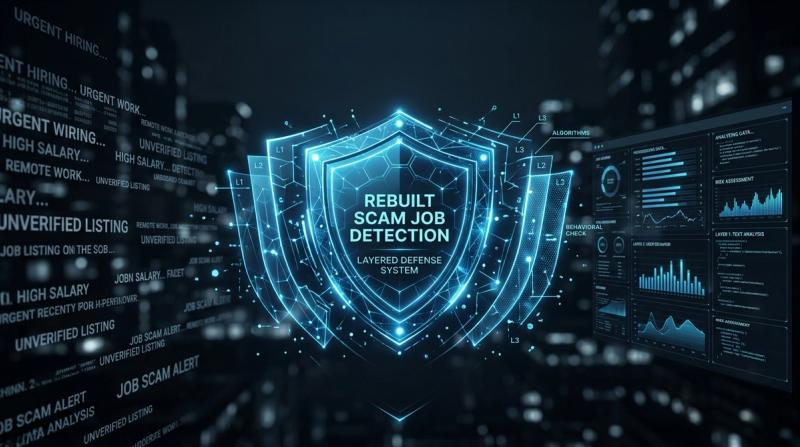
Our old scam-detection research was written for job scams that don't really exist anymore. Here's what actually changed, and how we rebuilt the system to catch it.
Why We Rebuilt Our Scam Job Detection From Scratch
A few years ago, I put together a list of what to watch for when scanning job listings for scams. It worked well enough at the time; I was able to filter out most scams before I even saw them in the app. Then I went back to look at it recently and realized something uncomfortable: most of it was written for a version of job scams that no longer really exists.
That's not me knocking on my original research. It is just what happens when a threat evolves faster than the notes you took on it. So instead of patching around the gaps, we rebuilt the whole detection system. And I want to walk through why, because I think the "why" matters more than the feature announcement itself.
How Job Scams Have Changed Since 2024?
When I first built OneClick's scam screening, most of what I was watching for aligned with what job scams looked like back then: bad grammar, obviously fake company names, and listings that just felt off if you read them closely enough. A blocklist of known bad domains caught a lot of it. Combine that with a few obvious red flags, and you have something that worked.
The problem is that job scams in 2026 don't look like that anymore; they have evolved a few times.
AI-Generated Job Scams and the Rise of Task Scams
AI didn't just change how job seekers write resumes. It changed how scammers write job listings. The stuff that used to be an easy tell (typos, awkward phrasing, obviously fake companies) is mostly gone. Scam listings today are often polished, professional-sounding, and structurally identical to a real posting. Grammar quality isn't a signal you can rely on anymore, and honestly, that was the single biggest thing I had to unlearn.
At the same time, a specific kind of scam has grown quickly: the "task scam." It usually starts as a message on WhatsApp or Telegram, rather than a job board listing itself, something like rating products, watching videos, or "optimizing" e-commerce listings for a small payout. The first couple of payments are real, just small, to build your confidence that it is a legitimate opportunity. Then it flips: you're asked to deposit money to unlock the next tier, and that deposit is the entire scam. Federal Trade Commission data show job and employment scam losses climbed from around $90 million in 2020 to over $500 million in 2024, and task scams grew roughly fourfold in just one year.
Most of that activity happens after someone applies, in a private message, which means a job board scraper genuinely can't see it directly. But what we have found is that some of it does leak into the listing itself, usually in the form of an instruction to "continue this on WhatsApp" or "text us to proceed." That's a pattern we can actually catch at the source, and it's one of the clearest signals we found in the research.
Our 3-Layer Scam Detection System
The old system was one algorithm doing a single job. That got us through 2024 and into 2025. Recently when looking at trends on Linkedin and Indeed I realized this wasn't enough.The listings had gotten more sophisticated, and one check catching one pattern meant too much was slipping through the gaps.
No single layer has to catch everything. That's the point, and it's closer to how fraud detection works in banking or insurance, industries that have been fighting this fight a lot longer than job boards have.
The first layer runs on every single listing, automatically, no exceptions. It checks for the things that are close to certain disqualifiers: any request for a fee, deposit, or "training kit," any instruction to move the application process to WhatsApp or Telegram, pay that's wildly out of line with the role and experience level, or requests for sensitive personal information before an interview has even happened. None of this requires a human to look at anything. It has to run at the volume real job boards operate at, which, for us right now, means checking roughly 1,000 listings a day without a person in the loop.
The second layer looks across the dataset, not just one listing in isolation, The same description appearing under a dozen different fake company names is a pattern our detection system flags. We extend that same idea to salary data, the system is flagging listings where the pay is so far from what we'd expect for that role and location that it stops looking like an aggressive offer and starts looking like bait.
The third layer is reserved for the genuinely ambiguous cases, there are a small percentage of listings that don't clearly pass or fail the first two layers. That's where we bring in AI classification, deliberately scoped down to a narrow set of questions rather than a vague "does this seem like a scam." Keeping it narrow keeps the results consistent, and keeping it reserved for ambiguous cases keeps the cost sane at real scale.
Rebuilding this also meant being honest with ourselves about what a scraper can and can't see. Much of the scam activity happening right now occurs entirely off the job board, in private conversations that start after someone applies. No amount of listing-level detection catches that part directly. We can catch the moment a listing itself tries to route someone into that private conversation in the first place, which turns out to be one of the more consistent tells across everything we looked at.
Why Job Scam Detection Matters for Remote Workers?
I built OneClick after my own job search, which lasted months and involved being contacted by scammers daily. Fake recruiter messages, resume-writer upsells, all of it. That experience is a big part of why I never treated scam screening as a nice-to-have feature. It was the whole point.
We have blocked 967 jobs to date this month for possible scams, in addition to the 4378 we had blocked from January 2026.
That number keeps climbing every month, and it's not because scams are rare and we're just being careful. It's because there's a genuinely large volume of this happening, targeting people at one of the most stressful, high-stakes moments of their lives. Roughly 38% of job scams target remote roles, which is exactly the listing many job seekers are searching for right now.
Job Scam Warning Signs Checklist
You don't need to become a fraud analyst to protect yourself, but a few things are worth internalizing, given how this has shifted:
- A well-written, professional-looking listing is no longer proof that it's legitimate. Polish stopped being a reliable signal a while back.
- Any request to move the hiring process to WhatsApp, Telegram, or plain text messaging is a serious red flag, not a quirky one.
- No legitimate employer will ever ask you to pay a fee, buy a "starter kit," or deposit money to "unlock" pay you already earned.
- If the pay looks dramatically better than the role and your experience level would normally justify, treat that as a warning sign rather than a lucky break.
We built this system so you don't have to run those checks manually on every listing you come across. But the checklist above is worth keeping in your head regardless, because no detection system, ours included, is going to catch everything.
If you want to see how many scam listings we've screened out recently (we actively show them live as we find them) or run your own resume through a free check, you can do that anytime at check.oneclicksmartresume.com. And if you're a veteran, you already have free access to the full platform, no catch.
FAQ
How can you tell if a job listing is a scam in 2026?
Grammar and typos are no longer reliable signals since many scam listings are now AI-generated and read as polished as real ones. The clearer signs are a request to move communication to WhatsApp or Telegram, pay that's dramatically higher than the role would justify, or any request for payment, a deposit, or a "starter kit" before you've been hired.
What is a task scam?
A task scam usually starts as a message on WhatsApp or Telegram, often after applying to a listing, asking you to complete small tasks like rating products or "optimizing" e-commerce listings for pay. The first payments are real and small, meant to build trust, before you're asked to deposit money to unlock further pay, which is the actual scam.
Are remote jobs more likely to be scams?
Roughly 38% of job scams target remote roles, since remote work already promises the flexibility that legitimate postings and scam postings both use as a draw.
Will a legitimate employer ever ask for payment?
No. A real employer will never ask you to pay a fee, buy a training kit, or deposit money to "unlock" pay you've already earned.
How many scam job listings has OneClick blocked?
As of this month, OneClick has blocked 967 scam listings so far this month, in addition to 4,378 blocked since January 2026.
AI Disclaimer: Claude was used to research this article, and I then used that research to write it in my own voice. I used Grammarly to correct spelling, grammar, and sentence structure.
References:
How fake job ads are scamming Australians out of money—and their identities - The Australia Today. https://www.theaustraliatoday.com.au/how-fake-job-ads-are-scamming-australians-out-of-money-and-their-identities/
Previous Article
← Why You're Not Getting Responses to Job Applications