BLOG
Job Scam Warning Signs in 2026: How to Tell If a Job Posting Is Real
Jul 30, 2026
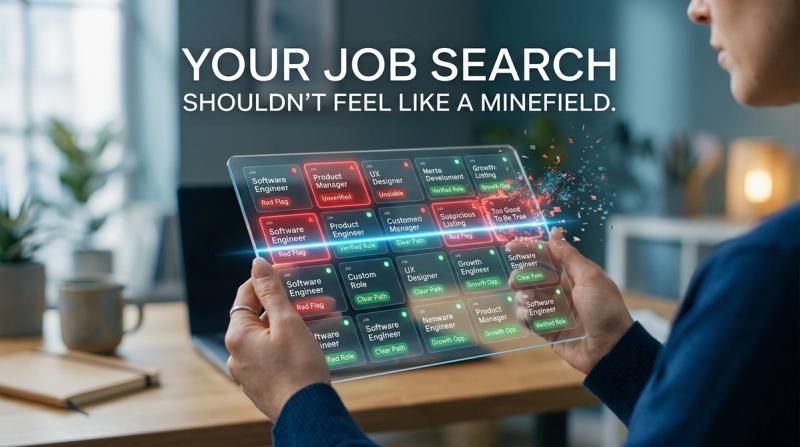
Our old scam-detection research was written for job scams that don't really exist anymore. Here's what actually changed, and how we rebuilt the system to catch it.
Our old scam-detection research was written for job scams that no longer really exist in 2026. Here's what actually changed in scam jobs in 2026, and how we rebuilt the system to catch it.
Your Job Search Shouldn't Feel Like a Minefield
At some point in the last few years, searching for a job stopped being just stressful and started being genuinely unsafe. Not in a dramatic, headline-grabbing way. In a quieter way, where you open a job board, start scrolling, and some part of your brain is running a background check on every single listing before you even let yourself get excited about it. Is this real? Is this company real? Why does this one pay so much more than it should? Should I be worried that they want to text me instead of email?
That background suspicion is exhausting. And the fact that it's necessary at all says something about how broken parts of the job search experience have become.
Filtering isn't the same thing as feeling safe.
Most job boards, if they do anything about scam listings at all, do it invisibly. Something gets filtered out somewhere on the backend, and you never see it happen. You're just left assuming the ten listings in front of you are the safe ones, with no real way to verify that assumption.
The problem with invisible filtering is that it asks for blind trust. You have no idea how thorough the screening actually is, whether it's keeping up with how scams have changed, or whether it's even working at all today versus the day it was built. Trust without visibility is fragile, and job seekers have plenty of reasons already to be skeptical of black boxes promising to look out for them.
How to Spot a Fake Job Listing?
The fix isn't just better filtering behind the scenes. Our belief is to making that filtering visible, so it stops being a promise you have to take on faith and starts being something you can actually see happening.
That's why every search on OneClick Smart Resum e shows you the numbers behind it in real time: We show you how many listings got flagged and blocked as likely scams, how many stale or expired postings got skipped, and how many jobs were actually screened and scored to get to the results in front of you. You're not just told, "We screen for scams." You watch it happen on your own search, every time.
There's something that shifts psychologically when you can see a number tick up in front of you as you search, instead of just reading a claim on an About page. It turns "trust us" into "here's the receipt." Let us be honest here, One of those is marketing. The other one is just true, and you can verify it yourself in the moment.
Remote Job Scams: Why They're More Common?
Remote roles get targeted by scams at a disproportionate rate, and it's not hard to see why. A remote listing already promises the thing a lot of scam listings dangle as bait: flexibility, no commute, work from anywhere. That overlap makes remote job seekers a specific target, which means the people who'd benefit most from a safer search experience are often the same people navigating the least amount of certainty about what's real.
If you're specifically hunting for remote work right now, that's exactly the moment to be more skeptical of polish and more reliant on actual verification, not less.
A safe place to look, not just a filtered one
Here's the single distinction we think matters the most: A "safe place to search" isn't just a job board with fewer scam job listings mixed in. It's the one where you're not carrying the entire burden of figuring out what's real, and where you have a way to check when something feels off.
That's part of why we built a feature that lets you flag a listing as illegitimate directly, feeding straight back into what gets screened out for everyone else searching after you. It's not a suggestion box that disappears into a void. It's part of the actual detection system, improving as people use it.
None of this means you can turn your brain off completely. No system, ours included, catches everything, and it never will, because scam tactics keep shifting just like everything else about how AI has changed the job search. But there's a real difference between navigating that alone and navigating it with a system that's actively working alongside you, showing its work as it goes.
The cost of getting this wrong isn't just wasted time.
It's easy to talk about job scams, as if the worst outcome is a wasted afternoon spent filling out an application that goes nowhere. That undersells what's actually at stake. Some of these schemes are after your Social Security number, a photo of your driver's license, or your banking details, all under the cover of what looks like a normal hiring process. Others ask for a small payment up front, framed as a training kit or a processing fee, and that payment is the entire scam. The damage isn't limited to the time you lost. It can follow you well past the job search itself.
That's part of why "just be more careful" has never felt like a satisfying answer. In our core believe being Careful is a mindset, not a system. It relies on you catching everything yourself, every time, on top of everything else a job search already demands from you emotionally and logistically. Systems exist precisely because individual vigilance, no matter how sharp, has limits, especially when the listings you're evaluating are specifically designed to look like they'd pass a careful look.
Transparency as a form of respect
There's a version of this conversation that treats scam job screening as purely a technical problem: build the right filter, catch the right patterns, done. That's true as far as it goes, but it misses something very important. Showing your work, letting someone see the actual numbers behind a claim instead of just the claim itself, that is also a form of respect for the person on the other end of the search bar.
Job seekers get talked down to a lot in this process. Ghosted after interviews, sent form rejections that clearly weren't written by a person, asked to jump through hoops that don't obviously connect to anything relevant to the job. Being transparent about what's actually happening behind a search result is a small thing in the scheme of all that, but it adds up. It's the opposite of the black-box experience that's become normal everywhere else.
Job Scam Red Flags Checklist
Even with screening in place, it's worth knowing what to watch for on your own:
- A listing asking you to move the conversation to WhatsApp, Telegram, or plain-text messaging before any real interview has taken place.
- Any request for a fee, deposit, or "starter kit" purchase, in any form, at any point in the process.
- Pay that's dramatically higher than the role and your experience level would normally justify.
- Requests for sensitive personal information, like a Social Security number or ID, are made before an actual interview.
If you want to see the transparency stats for yourself, run a search on OneClick and watch the numbers update as it screens results in real time. And if you're a veteran, the full platform is free for you, no strings attached. A job search is hard enough without also having to play detective on every listing you come across, and that's exactly the part we set out to take off your plate.
AI Disclaimer: Claude was used to research this article and rewritten using my own thoughts on the topic. Grammarly was used to correct spellling, grammar, and sentence structure.
References:
How to Know When to Trust Your Intuition: A Guide to Listening to Your Inner Voice - Peace of Mind 101. https://www.peaceofmind101.com/how-to-know-when-to-trust-your-intuition-a-guide-to-listening-to-your-inner-voice-2/ plate.
Previous Article
← Job Scam Detection in 2026: Why We Rebuilt It From Scratch