BLOG
The ATS Doesn't Reject You. It Just Makes Sure You're Never Seen.
Jun 25, 2026
If you're job seeker number 847 out of 1,200, and the ranking algorithm puts you on page 4 out of 30, you don't exist. Not in any way that matters to your job hunt.
I finished third for a role. Then third again. Then a third time.
Nine times in two months, I made it to a final round with hiring teams who genuinely wanted to move me forward. And nine times, I heard silence after the next step. No rejection email. No, "we went another direction." Just the kind of nothing that tells you the decision was already made upstream, in a conversation you were never in.
During that stretch, I learned something that changed how I thought about job searching: the ATS debate isn't really about whether your resume gets rejected. It's about whether you ever get a real chance at all.
The "Myth" Crowd Isn't Wrong. They're Just Missing the Point.
I would like to start here because it matters. The people who argue that "ATS rejection is a myth" are pointing at something real. Modern recruiting systems aren't simple keyword filters that binary-reject your resume the moment you lack an exact phrase. They're ranking engines. They assign scores. They order candidate pools.
That part is true.
But if you're a job seeker number 847 out of 1,200, and the ranking algorithm puts you on page 4 out of 30, you don't exist. Not in any way that matters to your job hunt.
The mechanism isn't a wall. It's invisibility.
What Employers Actually Admit
Here's where the conversation shifts from theory to what's actually happening at scale.
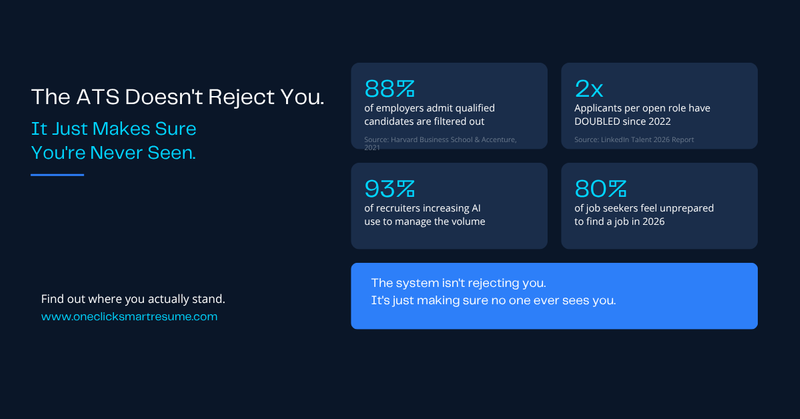
In 2021, Harvard Business School and Accenture published the "Hidden Workers: Untapped Talent" report. It surveyed employers across skill levels about their filtering practices. The findings were clear: 88% of employers say qualified, highly skilled candidates are filtered out because they don't match the exact criteria listed in the job description. For middle-skills roles, that number rises to 94%.
Over 90% of employers use their recruiting systems to filter or rank candidates initially.
These aren't edge cases or outliers. These are standard operating procedures, described by the employers themselves. Not as glitches. As an intentional process.
The Volume Problem Got Worse
Fast forward to early 2026. LinkedIn's Talent 2026 Report, covered by HR Dive in January, shows the picture has shifted again.
The volume of applicants per open role has doubled since spring 2022. One opening attracts twice as many applications as it did four years ago. At the same time, 93% of recruiters are increasing their use of AI in candidate evaluation. And here's the tension: 66% of recruiters say finding quality talent has become harder, despite the surge in overall volume.
More applications. Faster filtering. The same number of interviews.
That math doesn't work for job seekers. It works for systems that are designed to surface the top percentile, and it surfaces them faster.
Ranking Looks Like Rejection From Your Side
Let me be specific about what this means for your application.
A recruiter posts a role. They ask for Python, React, AWS, and three years of experience. You have all four. But you describe your Python work as "backend development" instead of "Python," your React experience as "front-end implementation" instead of "React," and you focus your AWS section on what you built rather than the specific services you used.
The system doesn't reject you. It reads the role requirements, scans your resume, finds language that doesn't map cleanly to those requirements, and assigns you a lower rank. The top 30 candidates, verbatim aligned with the job description, move to a review pile. You land in a tier below, a pile that the recruiter will reach if they don't find a suitable match in tier one.
They usually do find one.
You weren't rejected. You were ranked, and the outcome for your job hunt is identical: you never get reviewed by a human.
What You Can Actually Control
The good news: none of this is arbitrary. You're not at the mercy of an algorithm you can't influence. You're at the mercy of one that you can, if you know what to optimize for.
First: keyword alignment to the specific job description. Not keyword stuffing. Don’t fabricate skills you don't have. But intentional translation of what you've actually done into the language the job posting uses. If they say "project management," don't just say "coordination." If they say "stakeholder engagement," find the real moments in your work where you engaged stakeholders and name them explicitly.
Second: formatting that parses correctly. Different applicant tracking systems (Greenhouse, Lever, Workday, SmartRecruiters) parse resume structure differently. A resume that looks perfect in Google Docs might fragment when it imports into Lever. Bullets might misalign. Dates might misformat. Section headers might not parse. Your resume needs to survive the import intact, with all your key terms still connected to the right sections.
Third: outcome-focused language that works double duty. It needs to pass through the ranking software clearly (which means being explicit about what skills and outcomes you're highlighting), and it also needs to survive the 6-second human scan. The recruiter reviewing your resume needs to know immediately why you matter.
None of this is about gaming a system. It's about being visible to the system so that a human can actually evaluate you.
You Deserve to Know Where You Stand
The reason I built the Resume Health Check was that I lived through those nine near-misses and understood the invisible line between "ranked high enough to be seen" and "ranked too low to matter."
The ATS debate misses the real job seeker question, which isn't philosophical. It's practical: "Is my resume actually positioned to be found?"
That's something you can test. That's something you can fix. And that's something you deserve to know before you hit send on another 50 applications into a void.
You can run a free health check of your resume against the factors that actually matter right now: keyword alignment to real job postings in your field, parsing integrity across common systems, and the clarity of your outcomes. It takes about 10 minutes.
Check it at oneclicksmartresume.com.
You're not fighting the algorithm. You're fighting invisibility. And visibility is something you can build.