BLOG
Is the Harvard Resume Template Actually ATS-Friendly? We Tested It
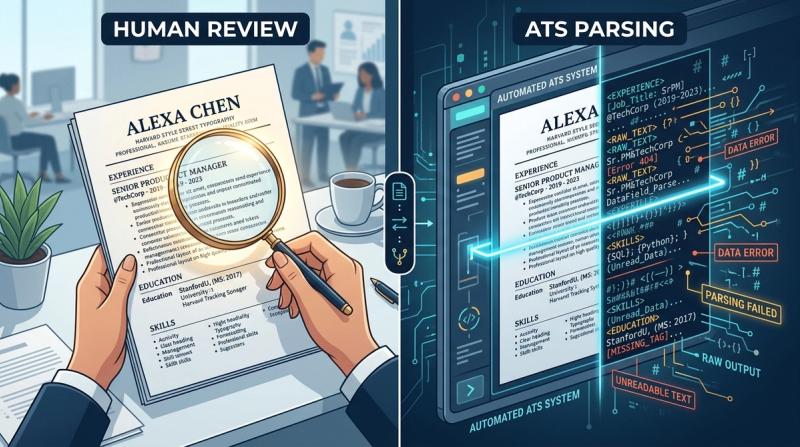
The free "Harvard resume template" gets downloaded constantly, but it was never built with modern ATS systems in mind. Here is what actually happens when it goes through one.
Everyone finds the same template
If you have searched for a resume template recently, you have probably run into it: the "Harvard resume template," sometimes labeled a Harvard CV format, showing up in nearly every search result for free resume help. It gets shared constantly because it looks clean, it is free, and the name carries weight. Harvard is a name people trust, so a template with that name attached feels like a safe choice.
We wanted to know if that trust was actually earned once the resume hits an Applicant Tracking System (ATS), which is where most applications go before a human ever sees them.
Want to know how your own resume actually scores? Run it through our free Health Check and see your ATS compatibility score in under a minute.
What an ATS actually does with a resume
An ATS is not reading your resume the way a person does. It is parsing it, pulling out sections, dates, job titles, and skills, and slotting them into fields a recruiter will search later. When that parsing fails, your information does not disappear exactly, but it can land in the wrong field, get garbled, or drop out of search results entirely. A recruiter searching for "project management" will never see you if your experience section did not parse correctly, even if you have ten years of project management experience sitting right there on the page.
This is the part that trips people up. A resume can look great to a human eye and still perform badly inside an ATS, because the two are reading it in completely different ways.
Most ATS platforms today run on a combination of rule-based parsing and keyword matching. Some are more forgiving than others. Workday, Greenhouse, and iCIMS all handle formatting slightly differently, which is part of why a resume can parse cleanly on one system and get mangled on another. There is no single universal standard every company follows, which is exactly why a rigid, one-size-fits-all template is a risky bet no matter how well designed it looks.
Where the Harvard-style template runs into trouble
The template that circulates under the Harvard name was built for readability on paper and on screen, which made sense when it was designed. It was not built with ATS parsing in mind, because that was not the problem it was solving. A few specific choices in that format tend to cause real friction:
Section headers that are not standard
ATS systems are generally looking for common header language: "Experience," "Education," "Skills." Some versions of the Harvard-style template use headers or formatting that read fine to a person but do not match what a parser is trained to recognize, which can cause an entire section to get skipped or mis-categorized.
Dense formatting and unusual spacing
Tight spacing and specific line structures can make a page look polished, but tight or unusual spacing between elements can cause a parser to merge two separate pieces of information into one field, or split one piece of information into two. Either way, what shows up on the recruiter's end may not be what you actually wrote.
No built-in guidance on keyword matching
The template itself has no mechanism for matching your resume language to a specific job description. It is a fixed format, not a living document that adapts to each role. Since most ATS systems rank candidates partly on how closely resume language mirrors the posting's language, a static template leaves that entirely up to you, and most people do not go back and manually adjust every resume for every application.
What we saw in our own data
Through our free Resume Health Check tool, we have looked at thousands of resumes against real job descriptions. Resumes built on the popular Harvard-style template have consistently scored lower on readability and formatting compatibility than resumes built in more ATS-forward formats. That does not mean everyone using that template is getting auto-rejected. It means the format is working against them in ways they usually cannot see, since there is no feedback loop telling someone their resume did not parse the way they expected.
See exactly where your resume stands. Upload it and a job description to our free Health Check and get a full breakdown across five scoring areas, including formatting and ATS compatibility.
What actually works better
None of this means you need to start from a blank page or hire someone to redo everything. It means being intentional about a few things most templates, Harvard-style or otherwise, do not handle for you:
- Use standard, ATS-recognizable section headers rather than creative or non-standard labels
- Avoid tables, columns, and text boxes for anything you want an ATS to actually read
- Keep formatting simple and consistent, since simplicity tends to parse more reliably than visual polish
- Tailor the language in your resume to match the specific job description you are applying to, rather than using one static version everywhere
- Check how your resume is actually being parsed before you submit it, rather than assuming a clean-looking PDF means a clean-parsing PDF
A few common questions
Does this mean the Harvard template is "bad" or a scam? No. It was never marketed as an ATS-optimized format, and it was not designed to be one. The problem is not the template itself so much as how it gets used now, as a generic, unedited, one-size-fits-all document sent to hundreds of different systems that were never built to read it the same way.
Can I still use parts of it? Sure. Clean typography and a straightforward layout are good instincts. The issue is less about aesthetics and more about the underlying structure, section headers, spacing, and whether the file format itself parses cleanly. You can keep what works visually while fixing what causes parsing problems underneath.
How do I know if my resume is actually a problem? The honest answer is that most people cannot tell just by looking at it, because the file looks fine to a human. The only real way to know is to run it through a tool that mimics how an ATS actually reads a resume, ideally against the specific job description you are applying to, rather than in a vacuum.
The bigger picture
None of this is really about one specific template. It is about understanding that a resume has two audiences now: the person who eventually reads it, and the software that decides whether that person ever sees it. A format built for one audience is not automatically built for the other, and that gap is where a lot of strong candidates lose ground without ever knowing why.
If you have been using the Harvard-style template and wondering why callbacks have been slow, it may not be your experience or your qualifications. It may just be the format standing between your resume and the person who was supposed to read it.
Ready to see the difference? Run your resume through our free Health Check, get your ATS compatibility score, and see exactly what to fix. No credit card required.
AI transparency: Claude was used to help research this article and augmented my own experience with Resume Templates and ATS systems.