BLOG
Ghost Jobs, Fake Recruiters, and What's Actually in Your Job Feed Right Now
Jun 24, 2026
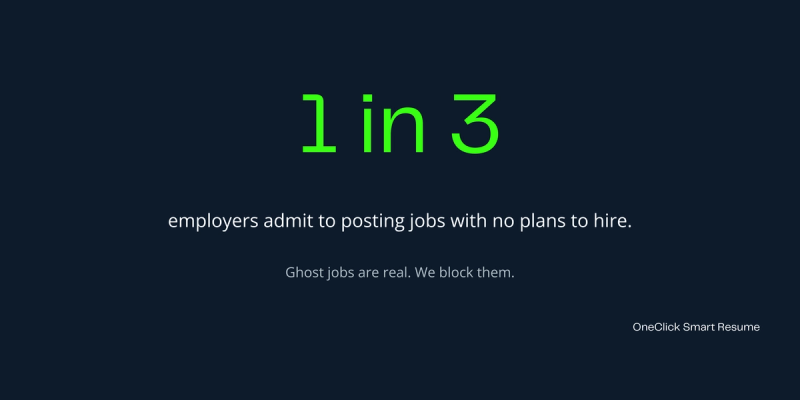
Nearly 1 in 3 employers admits to posting jobs with no intention of hiring. And that's before we get to the actual criminals. FTC-reported losses from job scams hit $501 million in 2024, triple what they were in 2020. Here's what's actually sitting in your job feed right now, and why the burden of figuring it out shouldn't fall on you.
You've been at it for weeks. You apply, you follow up, you hear nothing. You apply again. You craft a cover letter at midnight. You wonder what you're doing wrong.
Here's something nobody is telling you clearly enough: a significant portion of the jobs you're applying to may never have existed in the first place.
That's not a conspiracy theory. It's documented, and the numbers are far worse than most people realize.
The Ghost Job Problem Is Massive, and Getting Worse
A ghost job is a listing posted by a real company for a position they have no immediate plan to fill. They're not scams in the criminal sense, they're something arguably more insidious: real employers deliberately misleading job seekers to serve their own interests.
The data is hard to ignore.
A Clarify Capital study found that nearly 1 in 3 employers admit to posting job listings with no intention of hiring. That's not a rounding error. That's a structural feature of the job market that nobody warns you about when you start your search.
A separate analysis by ResumeUp.AI found that 27.4% of all U.S. job listings on LinkedIn are likely ghost jobs, with the U.S. having more ghost job listings than any other country.
Revelio Labs, a workforce intelligence firm, found that the rate of hires per job posting has essentially halved over the past five years. In 2019, there were eight hires for every 10 job postings. By 2024, that number dropped to four hires per 10 postings.
If you've been feeling like the job market is harder than the official numbers suggest, you're not wrong. Since the beginning of 2024, job openings have outnumbered actual hires by more than 2.2 million per month, according to Bureau of Labor Statistics data. The listings exist. The jobs, in many cases, do not.
Why Do Companies Post Ghost Jobs?
The motivations behind ghost job postings vary, but none of them benefit the people applying.
According to a Congressional Research Service report, employers post ghost jobs for several reasons: to signal growth and attract investors, to make current employees feel their positions are replaceable, to maintain the appearance of openness while an internal candidate is already lined up, or simply to cast a wide net for talent they may want in the future.
HR professionals have largely normalized the practice. 45% of HR professionals post ghost jobs "regularly," while 48% do so "occasionally." This isn't a fringe behavior. It's standard operating procedure at companies of all sizes.
The person paying the price is you. Your time, your energy, your hope, and in many cases your confidence.
Then There Are the Actual Criminals
Ghost jobs waste your time. Fake recruiter scams can cost you far more.
This is a different category entirely. Where ghost jobs come from real companies with cynical motives, fake recruiter scams are deliberate fraud, often sophisticated, and scaling fast.
According to the FTC, reports of job scams tripled from 2020 to 2024, with financial losses jumping from $90 million to over $501 million in that same period. That's half a billion dollars lost by job seekers in a single year, and that almost certainly undercounts the real number, since the vast majority of fraud victims never file a formal report.
LinkedIn now accounts for over 74% of all job scams on social media. The platform's reputation for professionalism is exactly what makes it such an effective hunting ground. When a message comes through LinkedIn, our guard is down in a way it wouldn't be with a cold email.
The playbook is consistent. A "recruiter" reaches out saying you have exactly the skill set they're looking for. You receive an official-looking interview invitation. After a virtual interview, you get an offer letter complete with the company's logo. Then comes the request: pay for your own equipment, with a promise of reimbursement. Or hand over your driver's license, Social Security number, or bank account details to complete "employment paperwork."
The reimbursement never comes. The job never existed.
The scale of the threat has changed dramatically. Deepfake fraud attempts in hiring jumped 1,300 percent from 2023 to 2024. Scammers are no longer sending poorly worded emails. They are using AI to generate personalized outreach that mirrors your professional history, building fake career portals that look identical to real company hiring pages, and in some cases running real-time deepfake video interviews impersonating actual company executives.
The Platforms Aren't Solving This for You
It would be reasonable to assume the job boards are handling this. They are not, at least not reliably.
In just the first half of 2025, LinkedIn removed over 117 million instances of spam and scams and restricted 84 million fake accounts. That scale of removal is extraordinary, and it also tells you exactly how many were getting through before detection.
Job aggregators, the services that pull listings from hundreds of sources and compile them into a single feed, have even less oversight. They're optimized for volume, not verification. A listing from a dubious source lands in the same feed as one from a Fortune 500 company, with nothing to tell you the difference.
Legislators are starting to push back. California passed legislation in March 2025 requiring employers to disclose whether a job posting is for an active vacancy. California and Kentucky have introduced additional bills to ban ghost jobs or mandate disclosure, and the FTC formed a Joint Labor Task Force in early 2025 with deceptive job advertising as a stated priority.
But legislation moves slowly. The scams and ghost jobs are happening now.
What You Can Do Today
There's no single fix, but a few habits will reduce your exposure significantly.
Verify the company's footprint independently. Before applying anywhere, search the company name on LinkedIn, check their website, and look for real employees. If a company with "500 to 1,000 employees" listed on the posting has 12 people on LinkedIn and a two-page website, take that seriously.
Check the posting date. According to typical hiring timelines from the Society of Human Resource Management, the average time to fill a role is 41 days. A posting that has been up for 60, 90, or 120 days with no update is a strong signal it's a ghost job or the role has already been filled internally.
Never pay for anything. Equipment deposits, background check fees, training materials, onboarding costs. Legitimate employers pay for these. No exception.
Verify recruiter email domains. Any recruiter contacting you from a Gmail, Yahoo, or Outlook address is an immediate red flag, regardless of what company they claim to represent.
Cross-reference job postings against the company's own careers page. If it's listed on Indeed but doesn't appear anywhere on the company's actual website, that's worth pausing on before you invest time in the application.
The Burden Is in the Wrong Place
Here's the uncomfortable truth underneath all of this: job seekers are being asked to individually verify every listing in a market that is structurally designed to obscure the truth. Ghost jobs pad employer pipeline numbers. Fake listings harvest personal data. Job boards incentivize volume over quality. And the individual applicant is expected to do their own intelligence work before every application.
That's not a sustainable system.
At OneClick Smart Resume, we built our scam screening layer because we lived through this problem firsthand. Every listing that reaches job seekers through our platform passes through a multi-layer screening process, starting with source trust ratings that weight listings from ATS-direct sources like Workday and Greenhouse more heavily than open feeds with less accountability, through rule-based checks that flag the most common fraud signals, and finishing with an AI scoring pass that catches the edge cases the rules miss.
Over 4,300 scam jobs have been blocked before they ever reached a job seeker on our platform.
The verification work shouldn't fall entirely on you. We've built the system to do it for you.
Sources referenced in this article:
- Clarify Capital, January 2025 employer survey on ghost job postings
- ResumeUp.AI analysis of LinkedIn job listings, 2025
- Revelio Labs workforce intelligence data on hires per job posting, 2024
- Bureau of Labor Statistics Job Openings and Labor Turnover Survey (JOLTS), 2024
- Congressional Research Service report on ghost jobs, 2025
- Federal Trade Commission Consumer Sentinel Network job scam data, 2020-2024
- Doppel recruitment fraud protection report, 2025-2026
- FTC Consumer Advice on fake recruiter scams
- Lloyd Staffing recruitment scams report, 2026
- Society of Human Resource Management average time-to-fill data, 2024